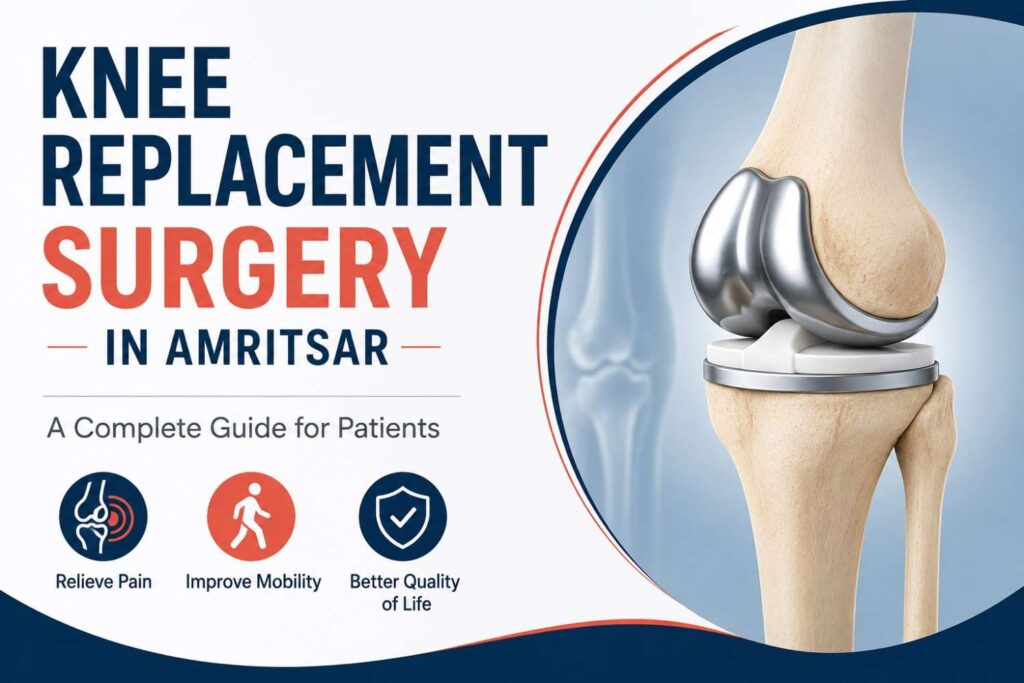
Persistent knee pain can gradually affect almost every part of daily life—from walking and climbing stairs to getting up from a chair or sleeping comfortably at night. While medicines, physiotherapy, weight management and other non-surgical treatments can help many patients, advanced knee damage may eventually require knee replacement surgery.
For patients considering knee replacement surgery in Amritsar, understanding the procedure, recovery process, possible risks and factors involved in choosing a hospital and orthopaedic surgeon can make the decision easier.
Knee replacement is generally considered when severe joint damage causes ongoing pain and limits daily activities despite appropriate non-surgical treatment. The procedure involves replacing damaged joint surfaces with artificial components designed to restore smoother movement.
This guide explains what patients should know before considering knee replacement surgery.
What Is Knee Replacement Surgery?
Knee replacement, also called knee arthroplasty, is a surgical procedure in which damaged portions of the knee joint are replaced with artificial components.
The knee contains the lower end of the thigh bone (femur), upper end of the shin bone (tibia) and kneecap (patella). Damage to the cartilage and joint surfaces can cause bones to rub against each other, resulting in pain, stiffness and reduced movement.
During a knee replacement, the damaged joint surfaces are removed and replaced with components generally made from metal and durable plastic materials.
The goal is to:
- Reduce chronic knee pain
- Improve knee movement
- Improve walking ability
- Make everyday activities easier
- Improve overall quality of life
When Is Knee Replacement Surgery Recommended?
Not everyone with knee pain needs knee replacement surgery.
An orthopaedic surgeon usually considers surgery when knee damage is significant and symptoms are interfering substantially with everyday life.
Knee replacement may be considered when a patient has:
- Severe or persistent knee pain
- Advanced osteoarthritis
- Significant knee stiffness
- Difficulty walking
- Difficulty climbing stairs
- Pain that interferes with sleep
- Difficulty performing routine activities
- Significant joint damage visible on imaging
- Limited improvement with non-surgical treatments
Doctors generally consider knee replacement after other appropriate treatments have not provided sufficient relief and pain or disability remains significant.
Does Age Determine Whether You Need Knee Replacement?
Age alone does not determine whether someone should undergo knee replacement.
Your surgeon considers several factors, including:
- Severity of joint damage
- Pain and functional limitations
- Overall health
- Bone and joint condition
- Previous treatments
- Activity requirements
- Expectations from surgery
A detailed assessment is important before making the decision.
Common Causes of Knee Damage
The most common reason for knee replacement is osteoarthritis, a condition in which the protective cartilage within the joint gradually wears down.
Other conditions that can contribute to severe knee damage include:
1. Osteoarthritis
Osteoarthritis can cause progressive cartilage damage, pain, stiffness and difficulty moving the knee.
2. Rheumatoid Arthritis
Inflammatory arthritis can damage cartilage and other structures around the knee.
3. Previous Knee Injury
Some fractures, ligament injuries or other significant knee injuries may contribute to long-term joint damage.
4. Post-Traumatic Arthritis
Arthritis can develop after a previous injury to the knee.
5. Other Joint Conditions
Certain less common diseases or conditions can also result in advanced joint deterioration.
Types of Knee Replacement Surgery
Depending on the extent and location of joint damage, different types of knee replacement may be considered.
Total Knee Replacement
A total knee replacement (TKR) is the most common form of knee replacement.
During the procedure, damaged surfaces of the knee are replaced with artificial components. It may be recommended when arthritis or other damage affects multiple areas of the knee.
Partial Knee Replacement
A partial or unicompartmental knee replacement replaces only the damaged portion of the knee.
It may be suitable for carefully selected patients whose arthritis is limited to one compartment of the knee. Because less of the joint is replaced, recovery can sometimes be shorter than after total knee replacement.
Your orthopaedic surgeon can determine which approach is appropriate based on your examination, imaging and overall condition.
How Is Knee Replacement Surgery Performed?
Before surgery, your orthopaedic team evaluates your medical history, medications, general health and knee condition.
Imaging such as X-rays may be used to assess the extent of joint damage.
During a typical total knee replacement:
- Anaesthesia is administered.
- An incision is made around the knee.
- Damaged joint surfaces are carefully removed.
- Artificial components are positioned.
- The knee is checked for movement and stability.
- The incision is closed.
- The patient is monitored in the recovery area.
The exact surgical technique, implant selection and anaesthesia plan vary according to the patient’s condition and the surgeon’s assessment. A typical knee replacement operation may take around 1–2 hours, although individual cases can vary.
What Tests Are Done Before Knee Replacement?
Before surgery, your healthcare team may recommend investigations to assess your overall fitness for the procedure.
These can include:
- Knee X-rays
- Blood tests
- Blood pressure assessment
- Medical history evaluation
- Medication review
- Anaesthesia assessment
- Other investigations depending on your health
Patients with conditions such as diabetes, high blood pressure, heart disease or other medical problems may require additional evaluation and optimisation before surgery.
Preparing for surgery may also involve improving fitness, maintaining a healthy diet, managing weight where appropriate and stopping smoking.
Recovery After Knee Replacement Surgery
Recovery is an important part of successful knee replacement treatment.
Patients are generally encouraged to begin movement and walking as advised by their medical team. Physiotherapists may guide exercises designed to improve strength, mobility and function.
Initially, some patients may need:
- A walking frame
- Crutches
- Walking support
- Pain medication
- Regular physiotherapy
- Home exercises
Recovery varies from patient to patient and can take several months.
Why Is Physiotherapy Important?
Physiotherapy helps patients gradually:
- Improve knee movement
- Strengthen muscles
- Improve balance
- Regain walking ability
- Return to everyday activities
Following your surgeon’s and physiotherapist’s instructions consistently is an important part of recovery.
How Long Does It Take to Recover From Knee Replacement?
There is no single recovery timeline that applies to everyone.
Recovery depends on factors such as:
- Age
- General health
- Muscle strength
- Type of surgery
- Pre-operative mobility
- Rehabilitation
- Presence of other medical conditions
Some patients become independently mobile relatively quickly, while complete recovery can continue for several months.
Your surgeon and physiotherapy team can provide a recovery plan based on your individual condition.
Benefits of Knee Replacement Surgery
For appropriately selected patients, knee replacement can provide significant improvement in pain and mobility.
Potential benefits include:
- Reduced knee pain
- Improved mobility
- Better ability to perform daily activities
- Improved walking
- Increased independence
- Better quality of life
The aim is not simply to replace the damaged joint but to help the patient regain useful function and participate more comfortably in everyday activities.
Risks and Possible Complications
Like any major surgery, knee replacement has potential risks. Most patients do not experience serious complications, but it is important to understand them before making a decision.
Possible complications include:
- Infection
- Blood clots
- Bleeding
- Nerve or blood-vessel injury
- Persistent pain or stiffness
- Difficulty bending the knee
- Knee instability
- Problems involving the artificial joint
- Need for additional surgery in some cases
The individual risk depends on factors including age, general health and medical history.
Your orthopaedic surgeon should discuss the potential benefits and risks with you before surgery.
How Can Patients Prepare for Knee Replacement?
Good preparation can help patients approach surgery and rehabilitation more confidently.
Before Surgery
Patients may be advised to:
- Follow prescribed exercises
- Maintain appropriate physical activity
- Manage existing health conditions
- Follow medication instructions
- Maintain a healthy diet
- Stop smoking
- Arrange help at home after surgery
- Prepare a safe area for walking
- Arrange transportation
Your doctor may also recommend pre-operative physiotherapy or specific exercises depending on your condition.
What Should You Look for When Choosing Knee Replacement Surgery in Amritsar?
Choosing the right hospital and orthopaedic surgeon is an important decision.
Patients should consider:
Experienced Orthopaedic Team
Look for an orthopaedic surgeon with experience in joint replacement and, where required, complex or revision joint replacement.
Appropriate Surgical Facilities
The hospital should have suitable operating facilities, diagnostic support, anaesthesia services and post-operative care.
Rehabilitation Support
Physiotherapy and rehabilitation are important components of recovery.
Individualised Treatment Planning
Every knee is different. Your treatment plan should be based on your symptoms, imaging, health and functional requirements.
Clear Communication
Your healthcare team should explain the procedure, expected recovery, risks and realistic outcomes before surgery.
Knee Replacement Surgery at Anand Hospital, Amritsar
Patients looking for knee replacement surgery in Amritsar can consult the orthopaedic team at Anand Hospital, Amritsar for evaluation of persistent knee pain and joint problems.
The hospital’s orthopaedic services include joint replacement, revision joint replacement, trauma and fracture care, sports injuries and rehabilitation.
For complex or previously operated knee replacement cases, consultation with an experienced revision joint replacement surgeon can be particularly important because revision procedures may require more detailed assessment and planning.
Meet the Orthopaedic Specialist
Dr. Saravpreet Ahluwalia
Revision Joint Replacement Surgeon
His qualifications include:
- MBBS
- MS (Orthopaedics)
- DNB (Orthopaedics)
- MCh (Orthopaedics), U.K.
- MRCS Ed, U.K.
- FEBOT, Switzerland
- FRCS Orth, U.K.
Patients can discuss their symptoms, diagnostic reports and treatment options during an orthopaedic consultation.
Frequently Asked Questions About Knee Replacement
1. Is knee replacement surgery painful?
Some pain and discomfort are expected after surgery. Pain management is provided during the recovery period, and discomfort generally improves as healing progresses. Physiotherapy and prescribed exercises are also important for recovery.
2. How long does a knee replacement last?
Modern knee replacements can provide long-term function. NHS guidance notes that many knee replacements last around 20 years or more, although longevity varies between individuals.
3. Can I walk after knee replacement surgery?
Walking is generally started progressively after surgery under the guidance of the healthcare and physiotherapy team. Patients may initially require a walking frame or crutches.
4. How long will I need physiotherapy?
The duration varies according to your strength, mobility, surgical procedure and recovery. Your physiotherapist will create a rehabilitation plan based on your progress.
5. Is total knee replacement better than partial knee replacement?
Neither is automatically better for every patient. The appropriate procedure depends on where the damage is located, the condition of the rest of the knee and other individual factors.
6. What is revision knee replacement?
Revision knee replacement is surgery performed to address a previous knee replacement that has developed a problem or requires replacement of some or all of the existing components.
Revision surgery can be more complex than primary knee replacement and requires careful assessment.
7. What is the cost of knee replacement surgery in Amritsar?
The cost can vary considerably depending on factors such as the type of implant, surgical complexity, hospital stay, investigations, medicines, rehabilitation and whether it is a primary or revision procedure.
Patients should request a personalised estimate from the hospital after clinical evaluation rather than relying on a generic online price.
8. When should I see an orthopaedic surgeon for knee pain?
Consider an orthopaedic evaluation if knee pain is persistent, worsening, affecting sleep or making walking and routine activities difficult—especially when conservative treatment has not provided adequate relief.
Key Takeaways
- Knee replacement is primarily performed to treat severe joint damage and relieve pain.
- Osteoarthritis is one of the most common reasons for knee replacement.
- Total and partial knee replacement are different procedures suited to different patterns of joint damage.
- A detailed orthopaedic assessment is necessary before surgery.
- Physiotherapy plays an important role in recovery.
- Recovery can take several months and varies between patients.
- Knee replacement has potential risks, so patients should discuss benefits and complications with their surgeon.
- Choosing an experienced orthopaedic team and appropriate rehabilitation support is an important part of treatment planning.
Conclusion
Living with severe knee pain can make simple everyday activities increasingly difficult. When non-surgical treatments no longer provide adequate relief and joint damage significantly affects quality of life, knee replacement surgery may be an option.
If you are considering knee replacement surgery in Amritsar, a consultation with an experienced orthopaedic surgeon can help determine whether surgery is appropriate and which treatment approach may best suit your condition.
Book an orthopaedic consultation at Anand Hospital, Amritsar, to discuss your knee pain, diagnosis and available treatment options.
Anand Hospital, Amritsar
📍 Inner Circular Road, Chatiwind, Amritsar
📞 7807940794 / 79731 01338